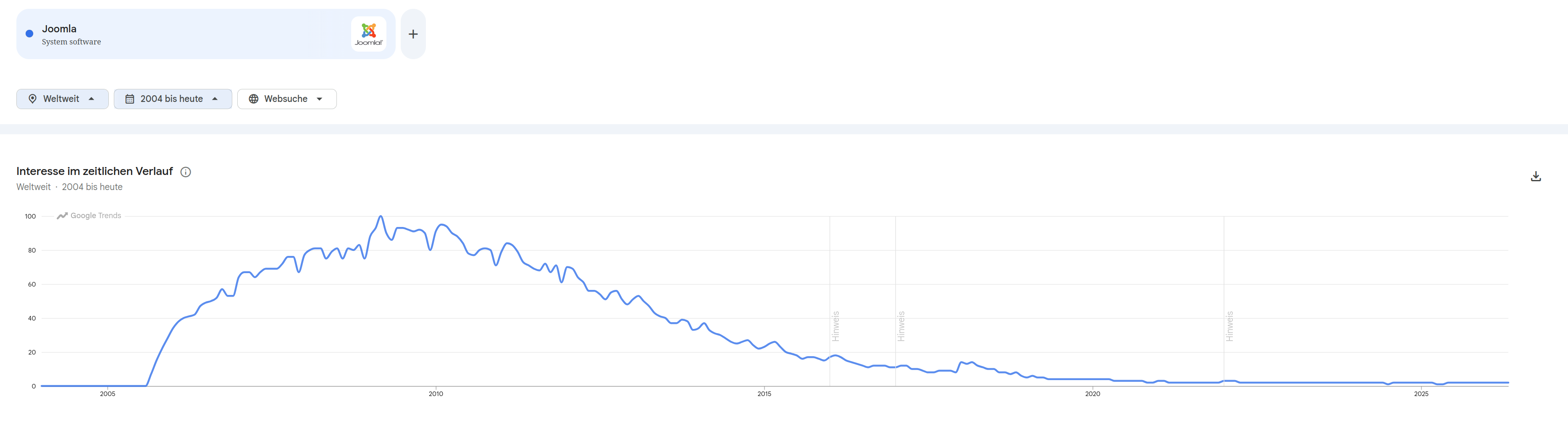
Joomla 3 support ended on August 17, 2023. It’s now obsolete and unsupported.
The Joomla team stated all users must migrate from Joomla 3 to 4 or 5 now, to be supported for malware and security fixes.
Joomla 5, released in October, 2023:
places a strong emphasis on code cleanliness.
introduces Fontawesome 6.4, Codemirror 6, and has updated its Webauthn Library.
now requires PHP 8.1, MySQL 8.0. 13+, MariaDB 10.4+, and PostgreSQL 12+ for optimal performance.
Granted, this curve looks very similar for many older projects (WordPress, Magento, Drupal, Moodle, …).
That is surely because of the diversification of ideas, the rise of the MERN stack and more recent Lovable and vibe coding in general. (already got two customers who are just vibe coding their portals).
Drupal focused on enterprise, it’s more complex to learn but it really shines for customer portals with just a few plugins and 0 code - I’ve got multiple partner portals / customer portals in production integrated with SuiteCRM and other CRMs, it’s really amazing!
WordPress is quite bad at multi language, login / customer area, field permissions etc. - one can install tons of plugins and create a Frankenstein CMS or custom develop everything.
Joomla was always positioned in the middle. More flexible than WP but not on the level of Drupal. I seldom had a use case for it.
Roughly: simple website - no brainer, WordPress. Complex website or customer portal - Drupal.
Vibe Coding tools in general. Lovable, Base44, Claude Code - anything that generates code. Lovable was the first / big / popular one from the AI era.
Nowadays non technical people build portals, internal apps, SaaS software, web apps, websites, etc.
I’m planning to release some content around it.
Customer portals (for me / my projects) are very specific to the customer journey / to the end users benefits.
I don’t think them from a CRM standpoint, but from a end-customer view standpoint.
The processes a user / customer goes through with one company are usually not a reflection of a few standard modules in the CRM (invoices + cases are popular for the ‘standard’ portals that don’t reflect the customers reality).